Quick answer: Adiabatic cooling uses evaporating water to lower air temperature in industrial spaces. When applied correctly, it can meaningfully reduce heat in targeted production zones, ease the load on conventional HVAC, and improve working conditions without replacing air conditioning entirely. Its effectiveness depends heavily on local humidity levels and application design.
Extreme heat is a growing operational challenge for industrial facilities. When temperatures climb, production quality suffers, equipment strains under the load, and workers become less effective. Facility managers and engineers are under pressure to find solutions that work fast, scale to large spaces, and don't require a complete overhaul of existing systems.
Adiabatic cooling is the process of using evaporated water to remove heat from the air. It’s one option that's gaining attention. But it's not a blanket fix. Understanding exactly how it works, where it performs best, and where it falls short will help you decide whether it belongs in your facility's heat management strategy.
How does atomized water remove heat from industrial air?
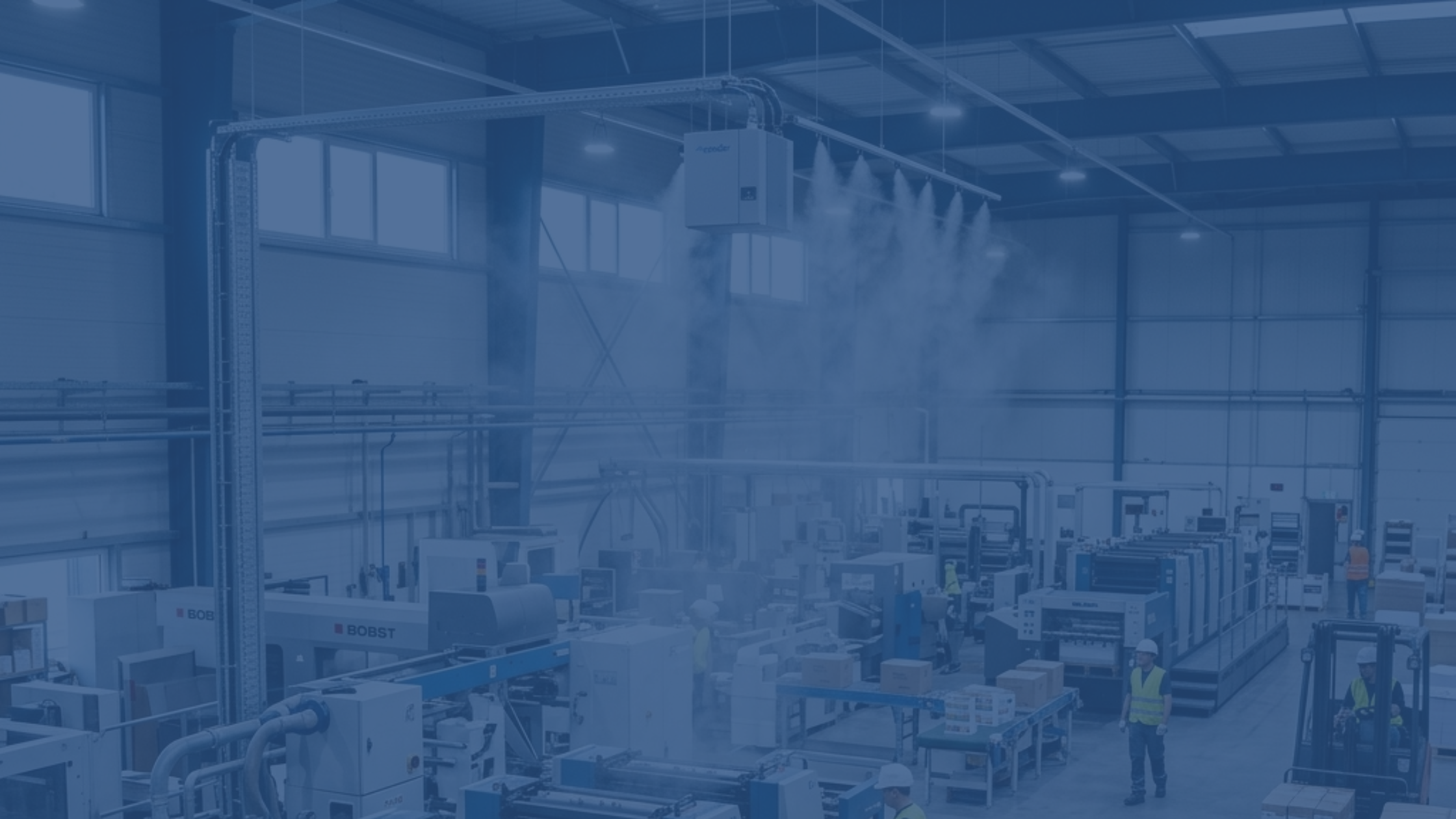
Adiabatic cooling works by converting liquid water into a fine mist or vapor. As those tiny droplets evaporate, they absorb thermal energy from the surrounding air, which pulls heat out of the environment in the process. The result is cooler, slightly more humid air.
The key word is "evaporation." If water droplets evaporate fully before they land on surfaces or equipment, the cooling effect is clean and efficient. If they don't, you get wet floors, saturated materials, and potential equipment damage. Proper atomization nozzle sizing and placement are critical to making this work in a real industrial setting.
The physics behind this process are straightforward: every kilogram of water that evaporates absorbs roughly 2,500 kilojoules of energy from the air. In large industrial spaces with significant heat loads, that adds up quickly.
What is the relationship between temperature and relative humidity in cooling applications?
Temperature and relative humidity (RH) are not independent variables. They move together in ways that directly affect how well adiabatic cooling can perform.
Hot air can hold more moisture than cold air. This means:
When temperatures rise, the air's capacity to absorb evaporated water increases
When RH is already high, the air is close to saturation, leaving little room for additional evaporation
Cooling potential is highest when temperatures are elevated and RH is relatively low
This relationship is captured in the concept of wet-bulb temperature. That is, the lowest temperature achievable through evaporative cooling alone. The greater the gap between the current air temperature and the wet-bulb temperature, the more cooling headroom you have. In hot, dry climates, that gap can be 10°C or more. In humid environments, it may be only 2–3°C, which significantly limits the system's effectiveness.
Where does evaporative cooling perform well in industrial facilities?
Adiabatic cooling delivers its best results under specific conditions. Facilities that meet these criteria are well-positioned to benefit:
Hot, dry climates where outdoor air is both warm and low in humidity
High-ceiling spaces such as warehouses, manufacturing halls, and logistics centers where hot air naturally rises and fresh air can move freely
Areas with strong heat sources like kilns, ovens, compressors, or heavy machinery, where localized cooling is needed
Facilities with good air circulation where misted air can distribute evenly without pooling
Wood processing facilities, textile manufacturing plants, and agricultural storage operations often see strong results, particularly during summer months when ambient conditions create a wide evaporation window.
What are the limitations of adiabatic cooling in already-humid environments?
This is where honesty matters. Adiabatic cooling is not a universal solution, and overselling it creates real operational problems.
In environments where RH is already elevated—typically above 60–70%—evaporative cooling loses most of its effectiveness. There simply isn't enough evaporation capacity in the air to generate meaningful temperature reduction. Attempting to push more moisture into an already-saturated environment can cause:
Over-humidification, which damages moisture-sensitive materials and products
Condensation on surfaces and equipment, increasing corrosion and slip risks
Microbial growth in standing water or saturated materials
Worker discomfort, since high humidity impairs the body's natural cooling through perspiration
Facilities in coastal regions, those with significant process-generated moisture, or spaces that already use humidification for production reasons need to evaluate adiabatic cooling carefully—and monitor humidity in real time before committing.
Should you target specific hot zones rather than the entire building?
In most industrial facilities, the answer is yes. Cooling an entire building through adiabatic means is rarely the most efficient approach. Heat loads are rarely distributed evenly—they tend to cluster around specific equipment, processes, or areas with poor ventilation.
A targeted approach delivers better results with less energy and less risk of over-humidification:
Identify the highest heat zones using temperature mapping or thermal imaging
Position atomization systems close to heat sources, such as above press lines, beside kilns, or near packaging equipment
Use directional airflow to carry cooled air toward workers and critical equipment
Separate zones with different humidity tolerances so you don't over-humidify moisture-sensitive production areas while cooling adjacent spaces
This zone-by-zone approach also makes it easier to monitor, adjust, and expand the system as needs change without committing to a facility-wide installation from the start.
How can adiabatic cooling reduce pressure on conventional HVAC systems?
One of the most practical applications of adiabatic cooling in industrial settings is as a pre-cooling stage for HVAC. Rather than replacing air conditioning entirely, evaporative systems can lower the temperature of incoming air before it enters HVAC units.
When an HVAC system draws in air that's already been pre-cooled by 5–8°C, it doesn't have to work as hard to reach the target temperature. The practical benefits include:
Reduced energy consumption during peak summer months
Less strain on compressors and cooling coils, which extends equipment life
Lower peak demand charges on energy bills
Improved consistency in areas where HVAC alone struggles to keep up
This hybrid approach—adiabatic pre-cooling combined with conventional HVAC—often delivers better results than either system alone, especially in facilities dealing with extreme summer heat loads.
How do you avoid over-humidification when using adiabatic cooling?
Over-humidification is a real risk if systems are designed or operated without proper controls. The goal is to add enough moisture to achieve meaningful cooling without pushing RH into ranges that cause problems.
Practical steps to stay in control:
Set upper humidity limits based on your most moisture-sensitive process or material
Install humidity sensors throughout the facility, not just at a single central point
Use demand-controlled systems that modulate output based on real-time temperature and RH readings
Incorporate interlocks that shut down or reduce atomization output when RH reaches a defined ceiling
Account for process-generated moisture such as steam, condensation, or wet materials, which adds to the facility's total humidity load
A system that runs at full output regardless of ambient conditions is a liability. Systems designed with feedback controls protect your products, your equipment, and your workers.
Why is monitoring both temperature and humidity critical for system performance?
Managing heat with adiabatic cooling means managing two variables simultaneously. Tracking only temperature gives you an incomplete picture. And incomplete data leads to poor decisions.
Consider two scenarios:
Scenario A: Temperature reads 34°C and RH is 35%. The evaporation window is wide, and adiabatic cooling can deliver meaningful results.
Scenario B: Temperature reads 34°C and RH is 68%. Pushing more moisture into that air will increase discomfort and risk damage, with little cooling benefit.
Without humidity monitoringems.com/our-solution, both scenarios look identical from a temperature standpoint. A monitoring setup that tracks both variables—ideally across multiple zones—gives operators the information they need to make real-time decisions. This is especially important in facilities where RH varies significantly between areas, or where outdoor conditions shift rapidly through the day.
Sensors should be positioned at worker height and near critical equipment, not just at air inlets where conditions look better than they really are.
Make Sure Your System is Set Up for Success
Adiabatic cooling can be a powerful tool for managing extreme heat in industrial facilities—but only when it's matched to the right conditions and designed with the right controls. A system installed without accounting for local humidity, process moisture, or material sensitivities can create as many problems as it solves.
If your facility is dealing with heat stress, rising energy costs, or struggling HVAC performance during peak summer months, it's worth exploring whether adiabatic cooling has a role to play. The right answer depends on your specific layout, your processes, and the climate conditions you're working with.
UTR Systems specializes in designing industrial humidification and evaporative cooling systems that are tailored to your facility's actual needs—not generic off-the-shelf solutions. Contact UTR Systems today to discuss your heat management challenges and find out whether adiabatic cooling is the right fit for your operation.
Frequently asked questions
What is adiabatic cooling and how does it work in industrial settings?
Adiabatic cooling uses the evaporation of fine water droplets to remove heat from the air. As atomized water evaporates, it absorbs thermal energy, lowering the surrounding air temperature. In industrial facilities, this process is delivered through high-pressure nozzle systems positioned near heat sources or air inlets, providing localized or zone-based cooling without refrigeration.
Can adiabatic cooling replace air conditioning in a factory or warehouse?
Adiabatic cooling is best used as a supplement to conventional HVAC, not a replacement. It works well for reducing temperatures in high-heat zones and pre-cooling incoming air to ease HVAC load. In already-humid environments or facilities with moisture-sensitive processes, it cannot fully replace mechanical air conditioning.
What humidity level is too high for adiabatic cooling to be effective?
Once relative humidity rises above approximately 60–70%, the air's capacity to absorb additional evaporated water decreases significantly. At this point, adiabatic cooling produces little temperature reduction and risks pushing conditions into ranges that damage materials, promote condensation, or create microbial growth risks.
How do you prevent over-humidification when using evaporative cooling?
Use demand-controlled systems that modulate output based on real-time temperature and humidity readings. Set upper RH thresholds based on your most sensitive process or material, and install sensors across multiple zones rather than relying on a single measurement point. Systems without humidity-based controls are prone to over-humidification during cooler or more humid periods.
Is adiabatic cooling energy efficient compared to conventional air conditioning?
Yes, in appropriate conditions. Adiabatic cooling uses water evaporation rather than refrigeration, which requires significantly less electricity. When used as a pre-cooling stage for HVAC systems, it can meaningfully reduce energy consumption during peak heat periods. Actual savings depend on climate, facility design, and how the system is integrated with existing equipment.
Who should I contact to evaluate whether adiabatic cooling suits my facility?
UTR Systems can assess your facility's layout, climate conditions, and production requirements to determine whether an adiabatic cooling system—or a hybrid approach combining evaporative and conventional cooling—is the right fit. Contact UTR Systems directly to request a consultation or facility assessment.